Hydration Injections Outperform Topicals for Denver's Driest Months
By
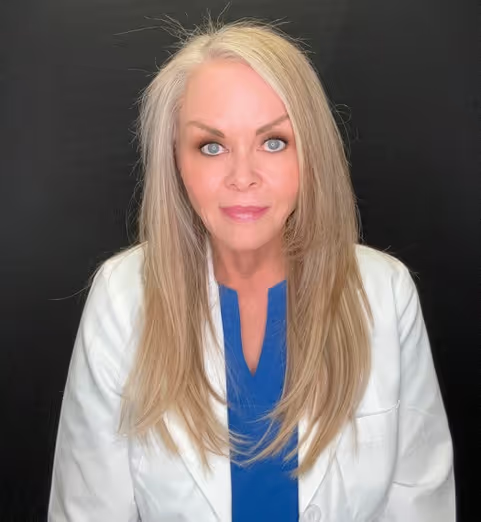
Kathi Kotelko, RN
August 8, 2026
5 min read
There's a specific kind of frustration that Denver skin knows well. You're doing everything right — the serums, the moisturizers, the overnight masks — and your skin still looks dull, tight, and older than you feel. You're not imagining it, and you're not doing it wrong. You're just fighting the environment with the wrong tools. Denver sits at 5,280 feet, where the air holds less moisture, UV exposure is significantly higher, and transepidermal water loss happens faster than it does at sea level. The topicals that work beautifully for your friend in Chicago or Atlanta are evaporating off your skin before they can do much of anything here. And once you understand that, the conversation about injectable hydration starts to make a lot more sense. Why Topical Hydration Has a Ceiling in Denver Moisturizers and hydrating serums work by either attracting water to the surface of the skin or forming a barrier to slow water loss. Both approaches have real merit — and neither one is a scam. But they're working at the level of the stratum corneum, the outermost layer of your skin. In a climate like Denver's, that outermost layer is under constant assault from dry air, wind, and UV radiation. You can keep layering product on top of it, but if the deeper layers of the dermis are depleted, topicals simply can't reach them. This is where injectable hydration treatments change the conversation entirely. Rather than sitting on top of the skin, they deliver hyaluronic acid — the molecule your skin uses to hold water — directly into the dermis, where it can actually bind moisture and support the skin's structure from within. What Injectable Skin Hydration Actually Does Products like SKINVIVE work by depositing micro-droplets of hyaluronic acid just beneath the skin's surface, creating what's essentially an internal reservoir of hydration. The result isn't volume or structural change — it's a quality-of-skin shift. Patients describe it as their skin looking lit from within rather than just moisturized on top. Smoothness improves. Glow improves. The kind of subtle radiance that makes people ask if you've been on vacation or sleeping better shows up, often within a few weeks of treatment. For patients dealing with more significant laxity and skin quality decline, bio-remodeling injections take this concept a step further. Rather than just hydrating, they stimulate your skin's own collagen and elastin production over time. The treatment delivers a highly concentrated, ultra-pure hyaluronic acid that disperses slowly through the tissue, prompting a genuine remodeling response rather than simply filling space. It's one of the more elegant approaches in aesthetic medicine right now — the kind of treatment that produces results that are genuinely hard to attribute to any one thing, which is exactly what most patients are looking for. The Denver Skin Problem These Treatments Were Made For If you've noticed that your skin seems to have aged more dramatically than your peers who live at lower altitudes, you're not overthinking it. Altitude accelerates skin aging in ways that catch Denver patients off guard, and hydration depletion is one of the primary drivers. The combination of lower humidity, higher UV index, and the physiological effects of altitude on skin barrier function creates a perfect storm that topical routines alone simply aren't equipped to address. The dry months — which in Denver can honestly stretch from October through April and beyond — are when this becomes most apparent. Skin that felt manageable in summer suddenly looks creased, flat, and tired. Foundation sits differently. Fine lines that were barely visible become more pronounced. Patients who come in during these months often describe the same thing: they've upped their skincare routine, they're drinking more water, and nothing is working the way it used to. Denver's dry air has a way of quietly dismantling even the most thoughtful skincare routines, and the patients who figure this out earliest tend to be the ones who make the shift to in-office treatments before the visible damage compounds. Who Benefits Most From Injectable Hydration The patients who respond most dramatically to injectable hydration treatments tend to fall into a few categories. First, there are those in their 30s and 40s who have noticed a decline in skin quality that doesn't match their age — the skin feels thinner, less bouncy, and drier than it used to feel despite good skincare habits. Second, there are patients in their 50s and beyond for whom moisture retention has become a genuine structural issue, not just a surface one. After 50, skin responds differently to almost every treatment, and hydration-focused injectables often serve as an essential foundation before or alongside any resurfacing work. Men are also discovering these treatments in growing numbers — perhaps because the results are genuinely natural-looking and the treatment itself is quick and low-key. Men in Denver are quietly booking more skin treatments than most people realize, and injectable hydration is increasingly part of that picture. How It Fits With Your Other Treatments One of the things that makes injectable hydration particularly valuable is how well it layers with other treatments. Patients who are doing Morpheus8 for skin tightening, HALO laser for resurfacing, or Sculptra for collagen stimulation find that maintaining strong skin hydration from within supports and extends the results of those investments. Hydrated skin heals more efficiently, responds to treatment more predictably, and holds results longer — particularly relevant in a climate that's constantly working against you. If you're already using HydraFacial as part of your routine, injectable hydration complements it well. Think of HydraFacial as addressing the surface — cleansing, exfoliating, and infusing — while injectable hyaluronic acid addresses the deeper layer that topical infusion can't reach. They're working on different levels of the same problem. It's also worth noting that combining treatments strategically tends to save Denver patients money over time by reducing how often individual treatments need to be repeated. When your skin's baseline hydration is stronger, everything else performs better and lasts longer. What to Expect at AOB Med Spa At AOB, injectable hydration treatments are always approached within the context of your whole skin picture. Jesica and Tara take the time to understand what's actually going on — not just what you're asking for, but what your skin needs and what's realistic for your timeline and goals. If bio-remodeling injections are right for you, they'll explain exactly how the treatment works, what the protocol looks like, and what kind of results you can realistically expect and when. The treatment itself is straightforward. A series of small, shallow injections are placed in a defined pattern across the face, neck, or hands depending on the treatment area. Most patients find it comfortable, with minimal downtime — typically some small bumps at the injection sites that resolve within 24 to 48 hours. Results build gradually over several weeks and continue to improve with a second session typically recommended about a month later. What patients consistently notice isn't one dramatic moment of change — it's more that at some point they realize their skin looks consistently better than it has in years. That kind of gradual, sustainable improvement is exactly what Jesica and Tara are aiming for. The Bottom Line on Topicals vs. Injectable Hydration Topicals are not useless — a well-designed skincare routine matters, and the team at AOB will always support yours. But in Denver's climate, topicals have a hard ceiling. They can maintain, but they struggle to restore. Injectable hydration works below that ceiling, delivering results that your most expensive serum genuinely cannot replicate. If your skin has felt persistently dry, dull, or thinner than it used to — and you've already tried doing more with your routine — it may be time to try doing something different. Denver's driest months don't have to show on your face. To find out whether injectable hydration is the right next step for your skin, reach out to the team at AOB Med Spa and schedule a consultation with Jesica or Tara.
Kathi Kotelko, RN
AOB Med Spa