After 50, Skin Responds Completely Differently to These Treatments
By
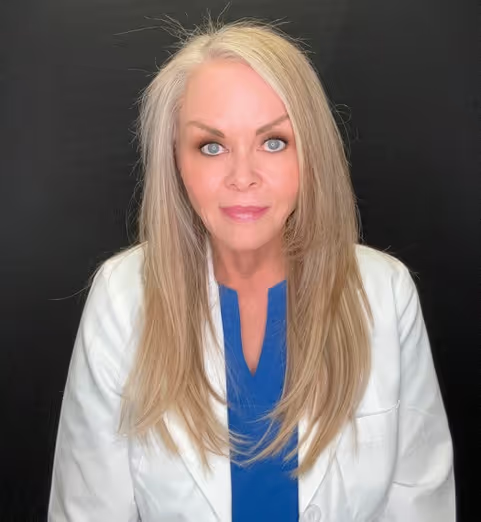
Kathi Kotelko, RN
July 17, 2026
5 min read
There's a specific moment a lot of patients describe when they come in. They've been doing everything right — sunscreen, retinoids, maybe a laser or two — and somewhere around 50, they notice the results just aren't landing the way they used to. The skin takes longer to heal. The texture improvements fade faster. The same treatment that left a friend glowing seems to produce something more subdued on them. They're not imagining it. After 50, skin genuinely behaves differently — and that changes everything about how treatments should be chosen, layered, and spaced. What Actually Shifts After 50 The changes aren't subtle, and they're not just cosmetic. Skin after 50 has measurably less collagen and elastin, a slower cellular turnover rate, reduced sebaceous activity, thinner epidermal layers, and a compromised barrier that's more reactive and less forgiving. For women, menopause accelerates much of this — estrogen plays a significant role in collagen production, hydration, and skin thickness, and its decline is felt in the treatment room. What this means practically: the skin is less resilient, slower to respond, and more prone to irritation. A 38-year-old might bounce back from an aggressive resurfacing treatment in a few days and see clean, even results. A 55-year-old with similar surface concerns may experience a longer healing window, more sensitivity, and results that require more patience and a more thoughtful approach to get right. This isn't a reason to avoid treatment — it's a reason to be smarter about it. Laser Resurfacing Works — But the Approach Has to Shift HALO laser remains one of the most effective tools available for patients over 50 who are dealing with texture irregularities, sun damage, fine lines, and uneven tone. As a hybrid fractional laser, it delivers both ablative and non-ablative wavelengths simultaneously, targeting both the surface and the deeper layers of skin. The results can be genuinely transformative for mature skin — but the protocol matters. At AOB, patients over 50 are typically counseled on modified energy settings, extended healing expectations, and the importance of skin prep in the weeks leading up to treatment. Patients who walk in with a compromised barrier — often from Denver's dry, high-altitude climate — need additional time to stabilize before any resurfacing is layered on top. Denver's altitude alone accelerates certain aspects of skin aging that aren't always accounted for in standard treatment protocols. MOXI laser offers a gentler entry point for patients who want meaningful improvement without significant downtime. It's particularly well-suited for patients over 50 who are earlier in their skin health journey or who have more reactive skin. MOXI isn't a compromise — it's a strategic choice that supports gradual, cumulative improvement with a more manageable recovery window. A series of MOXI treatments over time can deliver genuinely impressive results, especially when combined thoughtfully with other modalities. The Hydration Problem Nobody Talks About Enough Here's something that gets overlooked constantly: skin over 50 has a significantly harder time retaining moisture, and this affects how every treatment performs. Dehydrated skin is more vulnerable to irritation, heals more slowly, and simply doesn't produce the same luminosity that well-hydrated skin does after resurfacing. This is one of the reasons SKINVIVE has become such a meaningful part of treatment planning for patients in this age group. SKINVIVE by JUVÉDERM is an intradermal injectable that works differently from traditional filler — it doesn't add volume or change structure. Instead, it delivers hyaluronic acid directly into the skin tissue itself, improving skin quality, glow, and hydration from within. The results are subtle and natural-looking, but patients consistently notice that their skin looks healthier and more alive in a way that topical products simply can't replicate. For patients who are pursuing laser skin resurfacing in Denver, adding SKINVIVE to the broader plan — timed appropriately around treatment windows — can meaningfully extend results and improve baseline skin quality between sessions. When skin is better hydrated at the tissue level, it responds to laser energy more evenly and heals with less reactivity. Collagen Stimulation Takes on New Urgency — and New Strategy At 50, the body's collagen production has declined significantly. The skin isn't just losing what it has — it's producing far less of it on an ongoing basis. This changes the calculus around collagen-stimulating treatments considerably. Morpheus8 — which combines radiofrequency energy with microneedling to stimulate deep collagen remodeling — is particularly effective for patients over 50 who are dealing with laxity in addition to surface concerns. The RF energy reaches into the deeper layers of tissue where collagen scaffolding lives, triggering a remodeling response that can meaningfully improve firmness and definition over time. It's not a one-and-done treatment, but patients who commit to the protocol tend to see results that compound over months. Sculptra is another tool that becomes especially relevant after 50. Rather than replacing volume, Sculptra works by stimulating the body's own collagen production gradually over time. For patients over 45 and certainly over 50, the cumulative restoration that Sculptra provides tends to look more natural and more lasting than traditional filler alone — precisely because it's rebuilding the underlying structure rather than just filling space. Why Timing and Spacing Matter More Now One thing experienced providers understand — and patients sometimes don't — is that the schedule of treatments matters as much as the treatments themselves after 50. Skin that's been recently resurfaced needs adequate time to heal and rebuild before another treatment is layered on top. Pushing the timeline too aggressively can actually compromise results, trigger prolonged inflammation, or disrupt the barrier at a time when it's already working hard. At AOB, treatment planning for patients in this age group tends to look more like a conversation about a twelve-month arc than a single appointment decision. What needs to happen first? What sequencing makes the most physiological sense? How does Denver's seasonal dryness — which hits hardest in winter months — factor into laser timing? Timing laser resurfacing thoughtfully through Denver's seasons is something the team thinks about carefully, particularly for patients whose skin needs more time to recover and who may have less tolerance for the additional environmental stressors that come with post-treatment healing in a harsh climate. The Treatment Combinations That Tend to Work Best There's no single formula — every patient's skin is different, and a good provider will always customize. But there are combinations that consistently produce beautiful results for patients over 50: MOXI or HALO paired with SKINVIVE addresses both surface renewal and deep tissue hydration in a way that looks genuinely healthy and not overdone. Morpheus8 combined with Sculptra works on laxity and volume loss simultaneously through mechanisms that complement rather than compete. BBL Hero — broadband light technology — is remarkably effective for the pigmentation and redness that tends to compound over decades, and it's gentle enough to be incorporated into a broader plan without requiring long recovery windows. BBL Hero is particularly relevant for patients who have spent years in Colorado's high-altitude sun and are now seeing the cumulative effects surface all at once. Combining treatments strategically often makes more financial sense over time as well — something the AOB team is always happy to walk through honestly. What a Consultation at AOB Actually Looks Like for Patients Over 50 Patients over 50 who come to AOB often arrive with a mix of genuine optimism and some hard-earned skepticism. They've tried things before. They've had experiences that didn't deliver what was promised. They want results, but they also want to understand why a particular recommendation is being made for their skin specifically. That kind of conversation is exactly what Jesica and Tara are built for. The consultation isn't a upsell exercise — it's a genuine assessment of where your skin is right now, what's realistic, what the sequencing should look like, and what you can expect at each stage. Patients consistently describe feeling like the recommendation was designed for them, not recited from a menu. If your skin feels like it stopped responding the way it used to — or like the treatments you've tried haven't quite delivered — that's not a dead end. It's usually a signal that the approach needs to evolve along with your skin.
Kathi Kotelko, RN
AOB Med Spa