
Bunny Lines Are the Wrinkle Denver Patients Always Miss

Most Denver patients come in knowing exactly what they want to address. Forehead lines. Crow's feet. The "elevens" between their brows. But there's a small, expressive wrinkle that shows up in almost every mirror and almost every photo — and it almost never makes it onto anyone's treatment list.
Bunny lines. The little diagonal creases that fan out across the sides of your nose when you laugh, squint, or scrunch your face. They're charming in a child. They're something else entirely when they start showing up even when your face is completely at rest.
If you've never heard the term before, you're not alone. Bunny lines are one of the most commonly overlooked wrinkles in aesthetic medicine — and one of the simplest to address once you know what you're looking at.
What Are Bunny Lines, Exactly?
Bunny lines are the creases that appear on either side of the nose — typically starting at the bridge and extending diagonally down or across the nasal sidewall. They're caused by repeated contraction of the nasalis muscle, which runs along the sides of the nose and activates every time you scrunch, squint, or express strong emotion.
Like most dynamic wrinkles, bunny lines start as movement-only creases. Over time, with enough repetition, they can become etched into the skin and visible even when your face is relaxed. That's the point at which most patients notice them — usually in a photo — and wonder how long they've been there.
What makes bunny lines particularly sneaky is that they often get more noticeable after treatment in other areas. When the forehead and glabella are relaxed with Botox, the face naturally finds other muscles to recruit for expression. The nasalis, conveniently located and enthusiastically expressive, sometimes picks up the slack. Patients who've been getting Botox for years occasionally develop more prominent bunny lines as a result — not because something went wrong, but because the face is remarkably adaptive.
Botox for Bunny Lines: How It Works
Botox for bunny lines works exactly the way it works everywhere else on the face: a small amount of botulinum toxin is placed precisely into the nasalis muscle, temporarily reducing its ability to contract with full force. The muscle doesn't disappear — you can still move your nose, still smile, still laugh. What softens is the exaggerated crease that forms when the muscle fires repeatedly.
The injection itself takes less than a minute. The placement matters enormously. The nasalis sits close to other muscles that control lip movement and nostril flare, which means this is not a treatment that benefits from guesswork. An experienced injector will assess exactly where your bunny lines originate, how deep the movement is, and how much relaxation will give you a natural, balanced result without affecting adjacent structures.
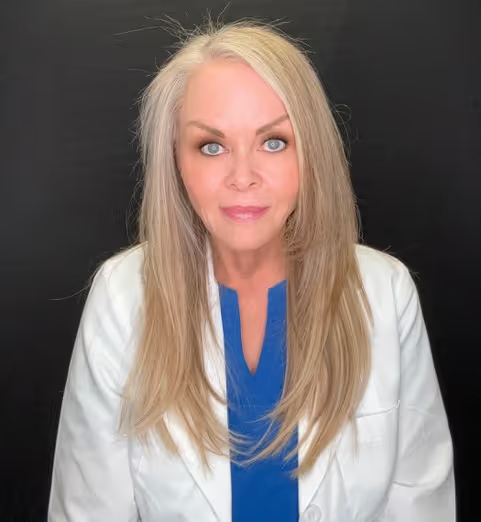
At AOB, that kind of precision is what Jesica and Tara bring to every treatment. They're not working from a template — they're reading your face, watching how you move, and making deliberate decisions about placement and dose based on what they actually see.
How Many Units of Botox for Bunny Lines?
This is one of the most common questions patients ask, and the honest answer is: it depends — but the range is typically small.
Most patients need somewhere between 4 and 10 units total to treat bunny lines, often split between two injection points on either side of the nose. Some patients with very active nasalis muscles or deeper established lines may need slightly more. Others with subtle movement and early-stage creases may see excellent results at the lower end of that range.
What's consistent is that bunny lines are one of the more dose-efficient areas of the face. Because the nasalis is a relatively small muscle, it doesn't take much to achieve a meaningful reduction in movement — which is part of what makes this treatment so appealing as an add-on to a broader Botox appointment.
The dosing conversation is always individual at AOB. Your provider will factor in your muscle strength, the depth of your existing lines, whether you're treating bunny lines in isolation or as part of a full upper-face treatment, and what outcome feels right for your face. If you've ever read about how differently Botox behaves in different facial zones, the nose area is another good example of why one-size-fits-all dosing misses the mark.
Who Is a Good Candidate for Bunny Line Botox?
Almost anyone who notices creasing along the sides of their nose during expression — or at rest — can benefit from this treatment. It's particularly well-suited for:
- Patients who already get Botox in the upper face and want to address a detail that's become more noticeable after treatment
- Patients in their 30s and 40s who are starting to see bunny lines deepen and want to prevent them from becoming static wrinkles
- Patients who photograph frequently and have noticed the lines in images even when they weren't aware of them in the mirror
- Patients who prioritize a naturally refreshed result and want their whole face — not just the obvious zones — to look consistent
The treatment is not typically recommended for patients who have significant concerns about nostril movement or lip symmetry, as the proximity of the nasalis to related muscles requires careful evaluation. That's another reason why having an experienced injector matters — not just for results, but for safety and appropriate candidacy.
What Results Look Like — and How Long They Last
Results from Botox for bunny lines follow the same general timeline as other areas of the face. Most patients begin to notice softening within three to five days, with full results visible around the two-week mark. The treated area moves less, the skin creases less, and the nose looks smoother both in motion and at rest.
Longevity is typically three to four months, consistent with most other Botox treatment areas — though individual factors like metabolism, muscle activity, and lifestyle can influence how long results hold. Some patients find that with regular treatment, the nasalis gradually becomes less hyperactive over time, and maintenance appointments feel less urgent. What happens to skin between and after Botox appointments is a question worth understanding if you're new to the treatment.
For patients curious about whether alternative neurotoxins might offer different duration profiles, a comparison of botulinum toxin brands is worth a read before your appointment.
Treating Bunny Lines as Part of a Complete Upper-Face Approach
One of the most valuable things an experienced provider can offer is the ability to see your face as a whole — not as a list of isolated complaints. Bunny lines rarely exist in a vacuum. They tend to appear alongside forehead lines, glabellar lines, and crow's feet, and the way you treat one area influences how the others behave.
When Jesica or Tara treats a patient for the upper face at AOB, they're thinking about all of these zones together — how they interact, how much relaxation is appropriate in each, and how the full picture will look once everything settles. Treating crow's feet and bunny lines in the same appointment, for example, is common because both areas contribute to how expressive lines read around the eyes and nose simultaneously.
Patients who want to go beyond the visible treatment zones sometimes ask about preventative Botox — starting earlier to reduce the depth of lines before they have a chance to become etched. Bunny lines are an excellent candidate for this approach, since they respond well to early intervention and the treatment is low-commitment in terms of both dose and cost.
A Small Treatment With a Surprisingly Polished Result
There's something satisfying about treating the details. Anyone can notice the deep forehead lines or the prominent crow's feet — but the patients who walk out of AOB looking genuinely refreshed, not obviously "done," are often the ones who've addressed the smaller things too.
Bunny lines are one of those things. They're not dramatic. They don't age a face the way hollowing or sagging does. But they're expressive, they're repetitive, and over time they leave a mark. Treating them is quick, affordable as an add-on, and remarkably effective when placed correctly.
If you've been getting Botox for years and never thought about the sides of your nose — or if you're new to injectables and want a provider who actually looks at your whole face — AOB Med Spa is ready for that conversation. Jesica and Tara have been doing this for a long time, and they genuinely enjoy the details. So does the rest of the team.
Book your consultation at AOB Med Spa in Denver and find out what a thoughtful, full-face approach to Botox actually looks like.
More from our blog
Explore articles on skin care, treatments, and wellness.